Find out which program is right for you - Masters in Business Administration or Masters in Management
There are some major differences between the two programs even though both the programs are very similar in more ways than we can think. Which one you should pursue after your graduation depends on your career goals and where are you now in terms of your career.
I have highlighted a few key differences between the two degrees that will make you decide between the two programs easily.
Experience
Both are graduate-level programs in business education. The curriculum of a Master in Management (MIM) program is not very different from the Master of Business Administration (MBA) program. The MBA is designed for more seasoned professionals with experience of 4–5 years of experience under their belt and the MIM is targeted at students right after their undergraduate or with 0–2 years of work experience.
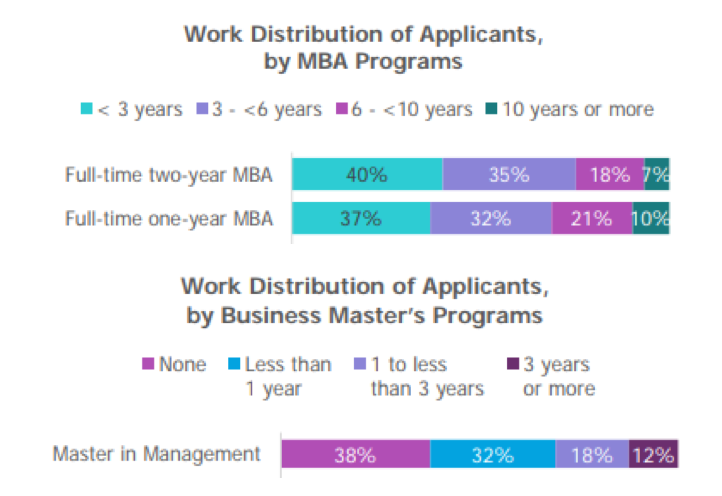
Work Experience distribution | Source: e-gmat
Placements
Since MBA programs admit students who have significant work experience in their bag, they are desired for mid-level managerial roles that demand higher responsibility and a higher paycheck. MIM graduates are mostly hired in entry-level positions. MBA graduates can expect salaries in the range of USD 100,000 - USD 150,000 on average while MIM graduates can expect around USD 60,000 - USD 100,000 on average.
Salary
- Duke University - MIM: $55,000, MBA: $140,000
- HEC Paris - MIM: $75,000, MBA: $140,000
- Northwestern Kellogg - MIM: $70,000, MBA: $145,000
- MIT - MSMS: $83,000, MBA: $168,000
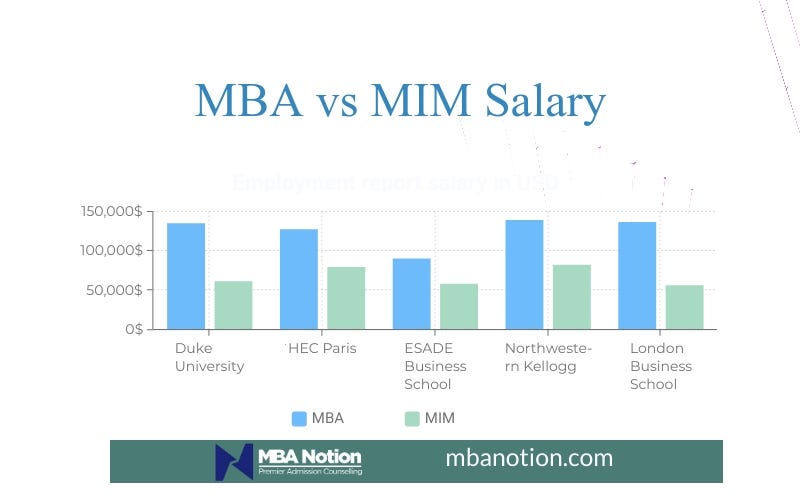
MBA VS MIM Salary | copyright — mbanotion.com
Recognition
MBA has been recognized the world over as the ultimate ‘business education degree’. MBA has greater recognition throughout the world and with all employers. Even though MIM is a new degree that originated in Europe nearly 20 years ago, it is gaining ground rapidly. It is mostly recognized in Europe and most employers in North America are agnostic of the degree but once explained they are accepting of the degree.
Tuition
An MBA degree can easily put a dent in your pocket with most top schools’ Cost of attendance ranging from USD 150,000 to USD 250,000. Mater in Management is a much more affordable option with tuition fees ranging from USD 30,000 to USD 80,000. Some schools eg. DUKE Fuqua has an accelerated MBA option for MIM graduates so you can top your MIM with a 1-year MBA after a few years of work experience.
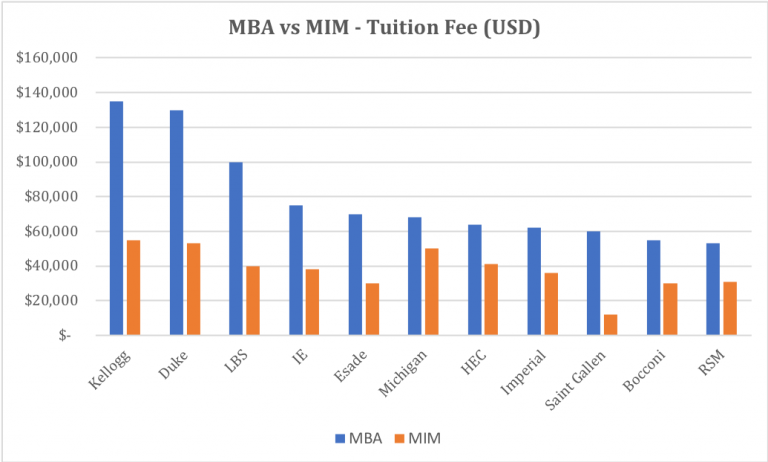
MBA vs MIM Tuition fees | Source: e-gmat
Duration
The MBA program in the US is mostly 2 years -the full-time residential program with an internship sandwiched in between the two years. The internship is particularly helpful for students who are looking to change industries. Whilst, MIM degrees are predominantly one-year introductory business degrees. However, few schools such as HEC Paris, Essec Business School, ESCP Business Schools have MIM programs that run for 2 years or more.
MBA and MIM programs are similar in many ways — they both require a general application process — GPA, GMAT/GRE, professional Resume, Essays, LOR, and Interviews. The academic experience and courses are similar but MBA has a more focus on experiential learning or more hands-on learning.
Learn more about programs and get to find the right program for free at findmyorbit.com
Getting into a MIM program is easier compared to an MBA program since MIM graduates don’t have to compete over impactful work experiences. Since the MBA is much broader and experiential, students can consider gaining some work experience and applying when it’s calling them.
Frequently Asked Questions (FAQ) about MBA vs. MIM Degrees
Q1: What are the main curriculum differences between an MBA and an MIM?
While core business subjects (finance, marketing, strategy) are covered in both, MBA curricula often emphasize strategic decision-making, leadership, and case studies reflecting real-world challenges faced by experienced managers. MIM curricula might be more theoretical or foundational, designed for those newer to business concepts. MBAs also tend to have more elective options for deeper specialization.
Q2: If I have 2 years of work experience, should I choose an MBA or MIM?
Two years of experience falls in a gray area. Many top MBA programs prefer 3-5+ years, but some accept candidates with 2 years if they have exceptional achievements. MIM programs typically target 0-2 years. Consider the average experience of students in your target programs. If your experience is strong and demonstrates leadership, an MBA might be feasible; otherwise, an MIM or a deferred MBA program could be a better fit.
Q3: Which degree offers better networking opportunities?
MBA programs generally offer more extensive and higher-level networking opportunities. This is because your classmates will be more experienced professionals from diverse industries, and alumni networks are typically larger and more established. MIM networking is valuable but will often be with peers at earlier stages of their careers.
Q4: Are internships common in both MBA and MIM programs?
Internships are a cornerstone of most 2-year MBA programs, typically occurring between the first and second year, and are crucial for career changers. For 1-year MIM programs, formal internships during the program are less common, though some programs may incorporate shorter projects or company engagements. Some 2-year MIM programs may offer internship opportunities similar to MBAs.
Simplify Your College Admissions Journey
If you're looking to simplify your college admissions process, check out Orbit! Orbit is a platform designed to streamline your journey, helping you find the perfect college match using 18 factors and over 60 attributes. Beyond just matching, Orbit also offers an AI essay editor, resume reviewer, a mentor marketplace, and other valuable tools to support your application every step of the way.
Topic Tags

(deleted thing)
December 27, 2025
An experienced writer and researcher focused on college admissions, this author simplifies the complex journey of applying to universities. They create practical, student-friendly content on entrance exams, application strategies, essays, and admission planning. With a strong emphasis on clarity and real-world guidance, their work helps students and parents make informed decisions, avoid common mistakes, and confidently navigate competitive admissions processes to find the right academic fit.






.jpg)